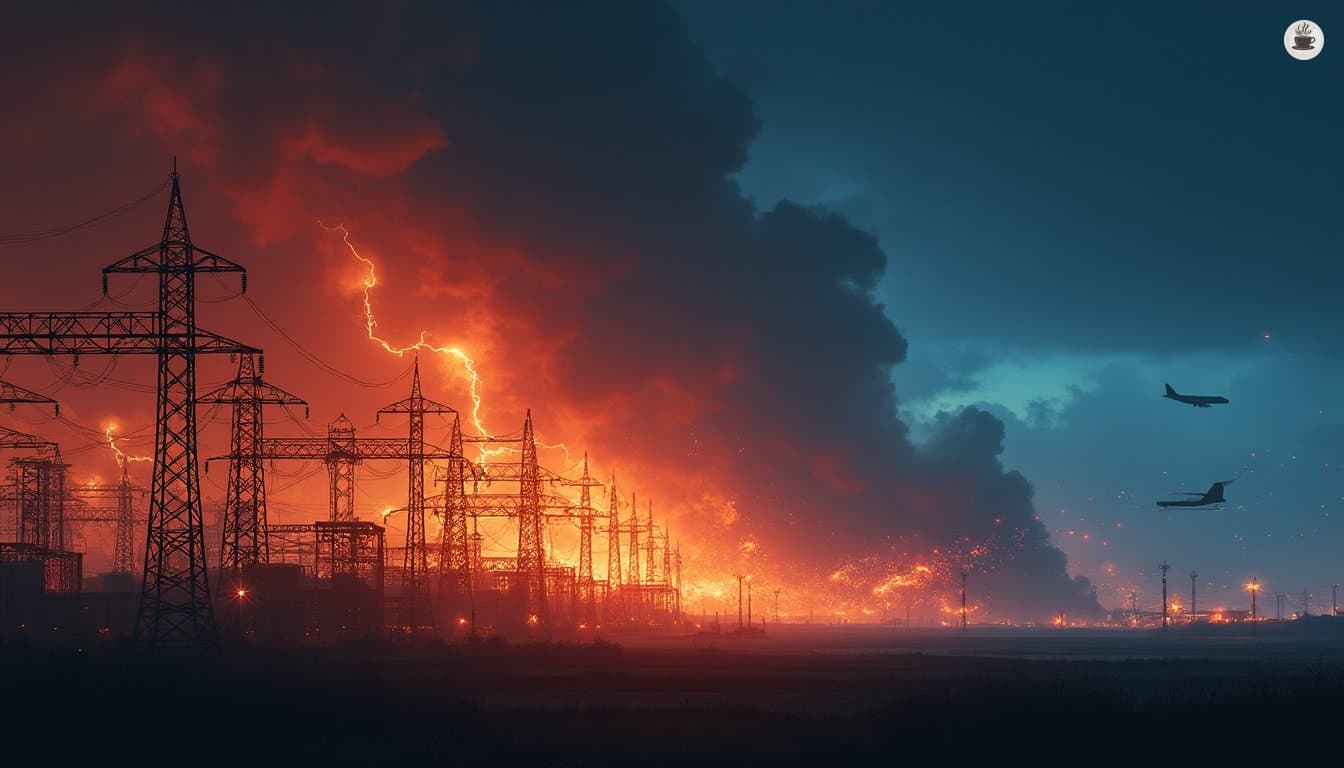
Major Fire at London Substation Forces Heathrow Airport Closure, Disrupting Over 1,350 Flights
Heathrow falls dark and still
Planes scatter worldwide
London's Heathrow Airport, Europe's busiest air hub, has been forced to close until midnight Friday after a major fire at a nearby electrical substation caused a widespread power outage, disrupting travel plans for hundreds of thousands of passengers worldwide.
The fire broke out at approximately 11:23 PM Thursday at the North Hyde electrical substation in Hayes, about two miles from the airport [1,3]. The London Fire Brigade deployed 70 firefighters and 10 fire engines to combat the blaze, which involved a transformer containing 25,000 liters of cooling oil [1].
The Metropolitan Police's Counter Terrorism Command is leading the investigation due to the incident's impact on critical national infrastructure, though authorities state there is 'currently no indication of foul play' [1].
According to flight tracking service FlightRadar24, at least 1,351 flights to and from Heathrow are directly impacted, including 679 arrivals and 678 departures [1]. The disruption affects approximately 200,000 passengers [1].
Energy Secretary Ed Miliband confirmed the fire had also knocked out the airport's backup power system. 'It's too early to say what caused this but I think obviously we will have to look hard at the causes and also the protection and the resilience that is in place for major institutions like Heathrow,' Miliband told BBC Radio 4 [1].
The incident has forced airlines to implement emergency measures. Flights have been diverted to various airports including Gatwick, Charles de Gaulle in Paris, and Shannon Airport in Ireland [1]. British Airways, which operates over half of Heathrow's flights, has advised passengers not to travel to the airport 'until further notice' [9].
Beyond the airport, the fire has affected local communities, with approximately 16,300 homes experiencing power outages [1]. Around 150 people were evacuated from surrounding properties, and a 200-metre cordon was established as a precaution [1].
Aviation consultant John Strickland warned that the disruption could last several days as airlines work to reposition aircraft and crews [1]. 'We're talking about several days worth of disruption to get the planes recovered and start using them again to move planned and disrupted passengers,' he said.